1867-1874 A Fresh Start
1867-1874 Rev A Bax
A fresh start was made in 1867. In January a former member of the Canterbury Baptist Church, who had moved to Faversham, discovered a few Baptists there and consulted his minister, Reverend A. W. Heritage, who encouraged him to go ahead and make further contacts. At the same time, Mr Heritage brought the matter before the committee of the Kent and Sussex Baptist Association. The association could not accept any responsibility but promised to give every possible assistance if a new start could be made. At the end of April, the use of the lecture hall of the Faversham Institute, opened in 1862, was hired for £1 a Sunday, including lighting, attendance and cleaning. On Wednesday 1st May, a public meeting was held in the lecture hall to inaugurate the new venture. There was not a large attendance. On the following Sunday, 5th May, Reverend A.W. Heritage conducted two services in the Institute. About 35 people attended in the morning and more than 50 in the evening.
The famous Reverend C.H. Spurgeon of the Metropolitan Tabernacle, London, gave practical encouragement. He gave generous loans free of interest and also arranged for one of his students, Mr Alfred Bax, to conduct services in the Institute each Sunday from 19th of May to the end of the year. The ministry of Mr Bax was much appreciated and the congregation increased. By the end of the year the morning congregation numbered 150 and the evening 300. There was no collection but boxes at the doors received free-will offerings. The Kent and Sussex Baptist Association made a grant of £15. The few Baptists in the town were greatly heartened and after further encouragement from Mr Spurgeon, it was decided to go ahead and try to recommence the Baptist cause in the town. On Sunday 24th November, Reverend A.W. Heritage was the preacher. The morning congregation was not less than 300 and there were nearly 500 present in the evening. A baptismal service was held the next day in Canterbury Baptist Church. There were four candidates who had been interviewed at Faversham the day before. Tuesday 26th November 1867 was the new birthday of the church. About 100 people sat down to tea. The secretary of the Baptist Association, Reverend R. C. Etheridge of Ramsgate, presided at the meeting which followed. A carefully drawn-up resolution was put to the meeting and carried unanimously. Eleven foundation members added their signatures to the resolution, which made it clear that they were Particular Baptists.
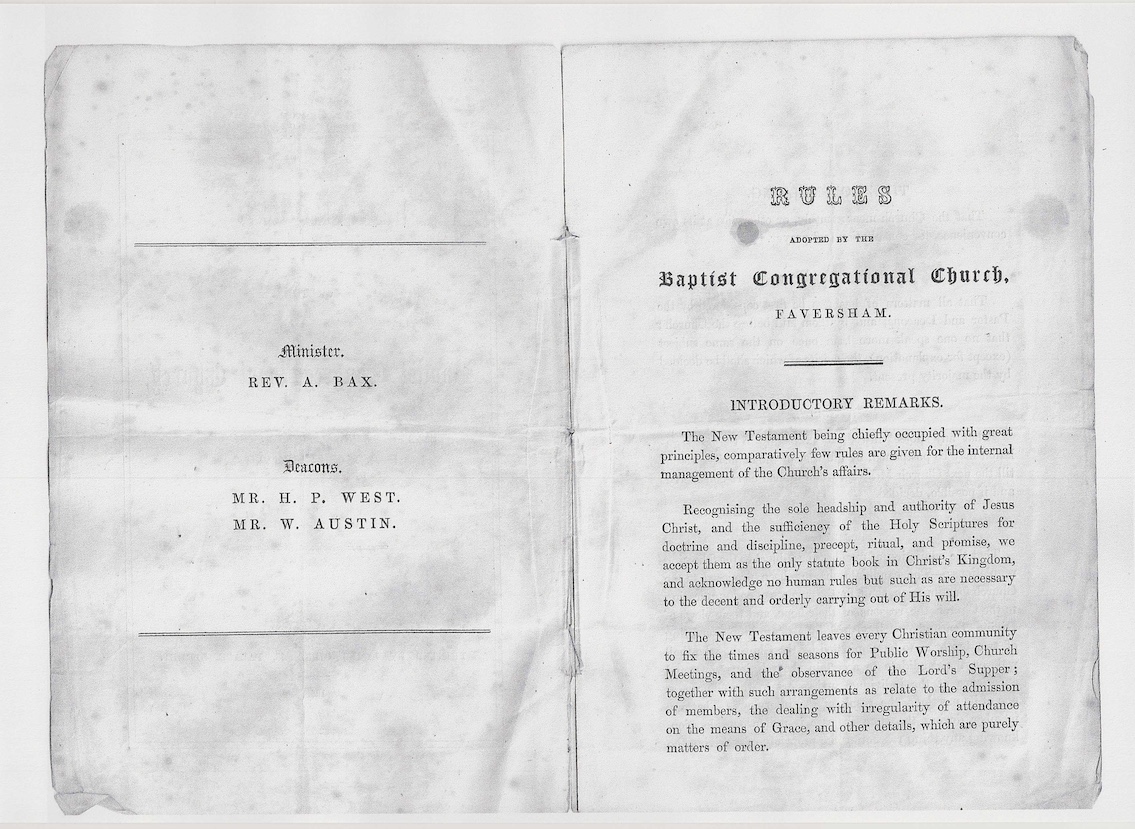 The first church members meeting of the newly-formed Baptist Church was held on 3rd February 1868. Twelve rules, occasionally referred to as ‘regulations’, were drawn up and approved. One rule was that ‘no one speaks more than once on the same subject (except for explanation)’. Another rule was that membership of the church would be forfeited by any member absent from worship during four successive meetings or from the Lord's table during six months ‘without sufficient reason’. Another rule mentioned as sufficient ground for church discipline, ‘immoral and fractious conduct and the denial of any essential part of the Bible’. Of the eleven members, two of them were appointed deacons. In April 1868 a letter of thanks was sent to the Gatefield Lane Assembly of Plymouth Brethren for their generous help in allowing the use of their meeting house and baptistry for a baptismal service on 8th March. By 1868 there were 31 members of the Baptist Church. In 1870 there were prolonged discussions at church meetings on the question of ‘open communion’. It was finally decided to allow non-members to come to the Lord's table provided that they gave evidence of a change of heart, but they must first be visited by messengers appointed by the church. In the same year, the name of a woman communicant was written off because she had unsettled the minds of some by what was considered to be unscriptural and unprofitable teaching. A Sunday school was begun in 1871, and a building committee was set up ‘to superintend all necessary business connected with the erection of a Baptist chapel in the town’.
Wednesday 31st July 1872 was a great day, for the Reverend C. H. Spurgeon himself, the most popular preacher of his time, came to Faversham to lay the foundation stone of the new Baptist church building and preach in the Institute. The stone can still be seen where he laid it. Behind it is a bottle containing the rules of the church and a record of its formation.
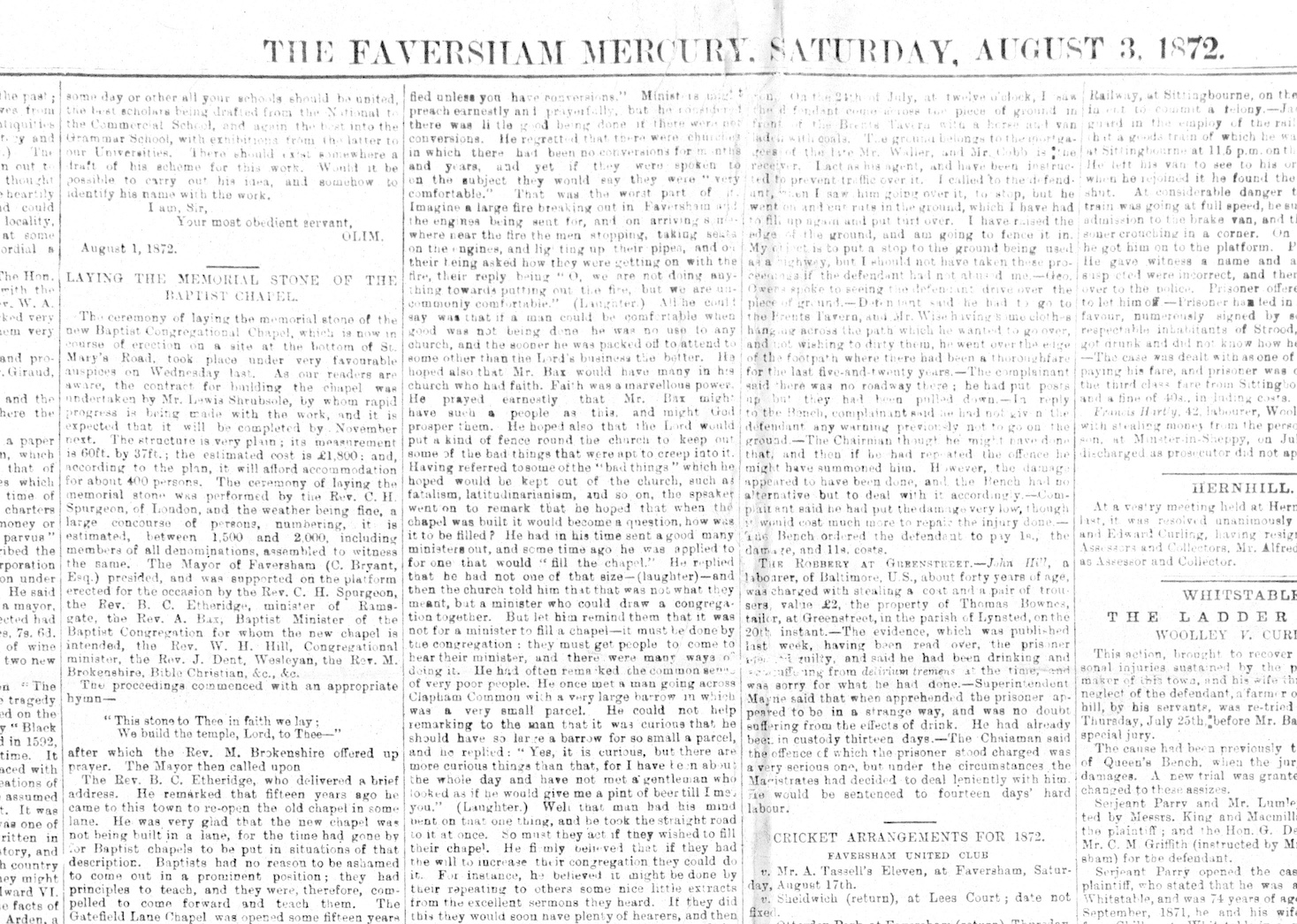
The Faversham Mercury of Saturday 3rd August carried a full account of Spurgeon's visit. A site had been selected at the bottom of St Mary's Road, by then mostly built up, and the contract for building the church had been let to Lewis Shrubsole, a prominent local figure who was to serve as mayor no less than six times. He was making rapid progress and expected to have the building completed by November. The design of the church, reported to the Mercury, was ‘very plain’. In a building 60’ x 37’, accommodation for about 400 persons was to be provided at a cost of £1,800, towards which about £880 had been raised before the stone laying ceremony.
The weather was good and a vast crowd of between 1,500 and 2,000 people turned up to witness the ceremony. The Mayor presided and the proceedings began with a hymn. The first speaker was Reverend R.C. Etheridge who had been associated with the abortive attempt to revive the Gatefield Lane Chapel in 1857 and had gone on to take a close interest in the congregation formed 10 years later. Ministers from the town's other non-conformist churches were at the ceremony and Reverend W. H. Hill of the Congregational Church spoke on their behalf. ‘We wish Mr. Bax every success in his work for Christ and hope his new chapel will be filled with a sterling congregation. I and my colleagues are here as friends of Christ and we're therefore glad to see another monument erected to the Redeemer's sacrifice and love in our behalf.’
This was the first point to which Reverend C H Spurgeon himself drew attention in his long address.
'I've had very great delight in meeting so many Christian ministers and this shows that they entertain a brotherly spirit and kindly feeling towards one another. I only wish I could say the same of every other town I visit.
No doubt, on an occasion of this kind, people will expect me to say something about our principles as Baptists. Well, be it known to all men that those who worship here will be known as thorough Protestants. And yet, I don't know that they are Protestants exactly, for the Baptists existed before the Protestants. They were the old Catholic and Apostolic Church of the first ages, from which the other churches sprang. Nevertheless, we're glad to associate with the younger branches of the family!'
Baptists are also called dissenters, but I don't know that they are. I believe our friends who go to the steeple houses yonder, the parish church, dissent from us as much as we do from them. As far as I can tell, the dissent is about equal on either side!’
After a few more comments in like vein, Spurgeon went on to congratulate Mr. Bax and the congregation on what had been achieved. As long as they remained united and stood together, God would stand by them. They would have to cultivate generosity too, and he emphasised that it was as much the job of the congregation as the Minister to attract people to fill the chapel.
There is no record of any decision to arrange for the opening service of the new chapel at which Reverend C. H. Spurgeon preached in February 1873. But there is a reference to a decision to celebrate the first anniversary of the opening in January 1874.
After a ministry of seven years Rev Alfred Bax was compelled to move away because of ill health.
11/08/2026